Showing posts with label crime lab. Show all posts

Tuesday, March 1, 2016

Sneaking Some Biology into Crime Solving Fun!

When asked how to make class more interesting, I often equate my strategies to sneaking veggies into dinner (or even dessert). It is about the presentation, conversation and outcomes that often distract students from being frustrated with their work or reluctant to give it a try. I truly believe it is about the attitude that we use to"serve" the dish of education.

The most recent "entree" I have been serving to my students is the annual forensic crime lab. I combine microscopy, fingerprint analysis, blood typing (synthetic, of course), blood spatter pattern, karyotype analysis and DNA profiling to narrow a list of 37 teacher suspects to one guilty murderer! 130 students are divided into groups to be the CSI for one of the suspects. They share their work in a common space and draw conclusions to end up with the guilty suspect.  This project takes three weeks to complete but can be modified for any schedule. Their main tool to use is their iPad to collect their photos and notes and then compile everything into a 5 minute "mock-umentary".

Please use this link to see the full description of the project.

Something new, added this year, is a two day blood spatter analysis. It was a huge hit and success for adding geometry into the mix! Use this link to get to the description of the blood spatter analysis from the Sherlock Holmes International Exhibit. It was a definite winner.

Projects are due at the end of the week, and I will be certain to share the best of show!

To learn more ways in which I am using technology in my classroom, follow me on Twitter @eglassman757.

Tuesday, April 8, 2014

It's a Matter of Crime!


One of the brightest parts of a very dreary time of year is our annual crime lab project. The main objective of the 9th grade biology crime lab is to provide our students with an opportunity to work in a collaborative setting to solve a problem while showing proper lab technique and technology skills. Some of the topics and techniques are review from other activities in the year and some are completely new to students.  We kick off the project with a lesson in evidence collection and technique from Joan Turner, City of Suffolk Community Outreach Coordinator and City of Suffolk Deputy Commonwealth's Attorney, Matthew Glassman. 
Here is how the project works...One teacher is the victim, one teacher is the guilty suspect and the rest of the faculty are other suspects to the crime. Students are divided into investigative teams (ideally 3 to a group)based on common free bells when possible.  Each group is then assigned one faculty suspect to interview, gather fingerprints and take a hair sample.  Based on hair and fingerprint analysis, the list of 40 (this number changes each year) suspects  drops to the Top 10. Students submit their choices via a Google form that must be completed by a deadline. By using karyotype analysis
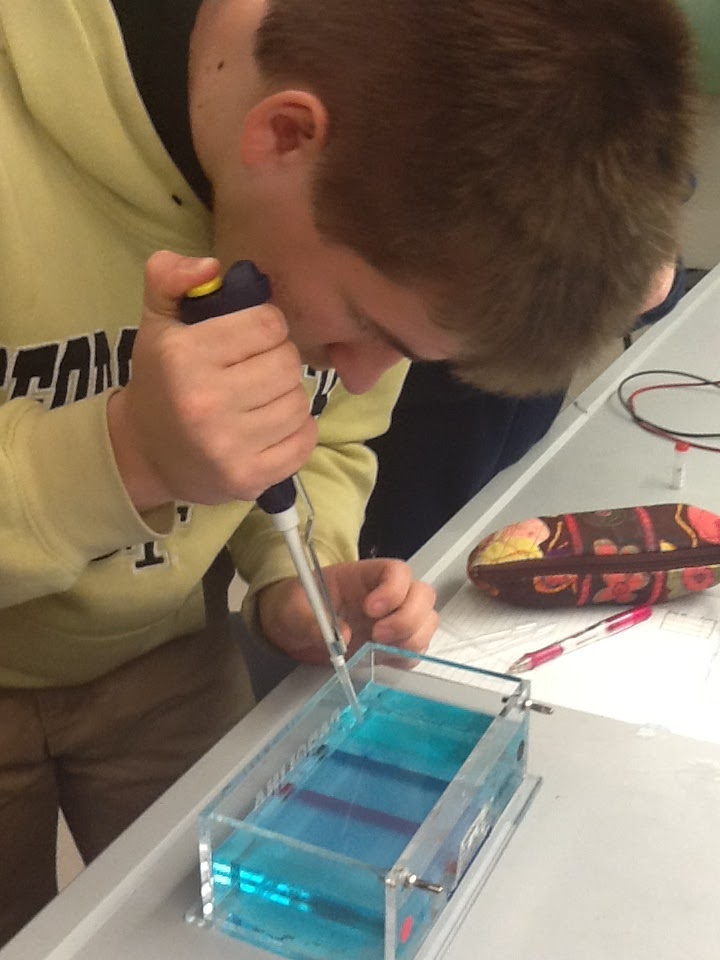
the list is shortened to four.  Using blood type analysis, students narrow the list to the final two suspects.  The final analysis of DNA identifies the guilty suspect. Testing that helps set the scene and motive of the crime include drug analysis and blood spatter pattern analysis.  While conducting the research and completing the lab work, students must document their findings with photos and notes collected on their ipad and shared in a Google doc with their group members.  Students must submit a packet of information on their first deadline which includes a final four data analysis chart, search warrant and crime scene sketch. The second deadline is a “mockumentary” video which is created using iMovie on the iPad. The video includes an explanation of the testing completed, results, and explanation of motive.  The project is conducted over a three week time frame.


My colleague, Scott Fowler, and I have been doing the crime lab project for the 13 years we have been teaching together.  With the addition of iPads, we are able to go mostly paperless and communicate with groups through shared Google docs. We have also changed from requiring a final paper to producing the "mockumentary" video.  I think this has allowed us to get a better understanding of student comprehension of the parts of the project since we have the opportunity to hear their explanation and see their interpretations.


As always, every project leaves me with ways to improve and refine the process. Here are my main tips if you choose to do something of this nature.

1. Intermediate deadlines are time saver.

2. Common free time for students is extremely helpful.

3. Clear grading expectations should be presented at the beginning of the project.

4. No last names in projects must be reminded to your students!

5. Patience, sense of humor and popcorn are a must.

To learn more ways in which I am using technology in my classroom, follow me on Twitter @eglassman757.


Sunday, March 17, 2013

Grab Your Popcorn! It's Crime Lab 2013 Movie Time!

I have never enjoyed grading as much as I did while viewing the movies created by my students for our crime lab. Here are the main lessons I learned from this project to remember for next year.

1. Only allow students to use first names in projects. I will not post anything on here that has a last name. That definitely limits me on the number of videos I can show you.

2. You can never have enough bandwidth when uploading projects. Thank goodness I was on spring break the week after projects were due. I was able to focus on getting the projects uploaded to Vimeo when no one else was on our network. Even at that, I averaged 10 minutes per iPad movie.

3. Check weekly limits for free video uploading so you don't have to pay.  Because I did not want to spend money when uploading videos, I could only upload about 20 movies a week. I was lucky to have my weekly limit reset on Tuesdays to get them all done.

4. Providing an iMovie tutorial is extremely helpful to keep frustration at a minimum.  Students were at different levels of comfort with the app so I made sure I was available to help learn the quirks with them and share anything learned from other students as the days progressed. There are some fabulous YouTube tutorials out there!

5. Be patient and prepared for failure. In anything new, especially technology minded, I have learned that what I think will take 20 minutes may take an hour. However, I have learned more from those failures than anything that goes right the first time through.

6. Be ready to have your socks knocked off! I am still marveled by my students. I am one proud "school mom"!

Grab your popcorn and enjoy the shows!


To learn more ways in which I am using technology in my classroom, follow me on Twitter @eglassman757.


Wednesday, February 27, 2013

Suspects and Crime tape and iPads, Oh My!

My students are currently finalizing their Crime Lab 2013 projects. This three week unit is what pushed me to start this blog. I was posting pictures and updates on Twitter, and actually had requests to blog about the project! So here goes!


I started doing a forensic science unit 12 years ago. It started with two suspects and four classes of students. It has now evolved into having 137 biology students divided into investigation teams (one per suspect), 42 faculty suspects and one faculty victim. My colleague, Scott Fowler, and I co-teach the unit for three weeks. It is fantastic to have flexibility in our schedules to work and collaborate as we do. It is also wonderful to have the opportunity to interact with every single 9th grade student in our school. This year's major change: an iPad is assigned to each team for the duration of the project.


The apps that have been most critical for this project are Explain Everything, Dropbox, Google Drive, and iMovie. This is also the point to recognize Ed Patterson, our Director of Academic Technology. He has been our "go to guy" for all questions iPad. He is patient with my questions, and flexible to meet and work with students. Having solid academic tech support is essential.

First, students are introduced to evidence collection by Joan Turner, City of Suffolk Education Outreach Coordinator, and chain of custody by Matthew Glassman, a Deputy Commonwealth's Attorney in Suffolk, Virginia.  Walking students through a case prior to their assignment has proven to be very helpful.


Students navigate through the project by completing a series of tasks and labs that narrow the suspect list from 42, to 10, to 4 to the top two suspects. DNA profiling reveals the guilty suspect. The highlighted activities include hair analysis, fingerprint analysis, blood spatter pattern, drug analysis, karyotype analysis, blood typing and DNA profiling. Three key points of any good evidence collector are photos, notes and sketches. As teams progress through the lab, they are able to do all of this in one organized location....the iPad.

Bottom line, iPads shouldn't ever replace collaboration, conversation, reading, writing, and data analysis. Students need to interact with each other. 

Stay tuned for the forensic teams' iMovie "Mockumentaries" that are due by Friday this week!

To learn more ways in which I am using technology in my classroom, follow me on Twitter @eglassman757